Aug 2026 – Present
Water Level Estimation
Compared detection, regression, hybrid models, and MoE for water level estimation using roughly 308,000 images across eight gauge types.
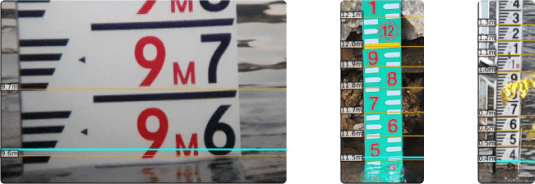
Overview
A computer vision project estimating water levels from eight gauge types with different markings and capture conditions. Using roughly 308,000 images, we compared detection-based formulas, regression, hybrid models, and Mixture of Experts (MoE), including their failure modes.
The final project model achieved RMSE 9.52cm on 30,808 Test images, including formula failures and undetected gauges.
- Period: August 2026 – Present
- Team: 5 AI developers
- Role: Data analysis and AI
- Environment: Linux · CUDA · RTX 3090
Contributions
- Analyzed gauge type, water level, and obstacle distributions in 308,085 image/label pairs.
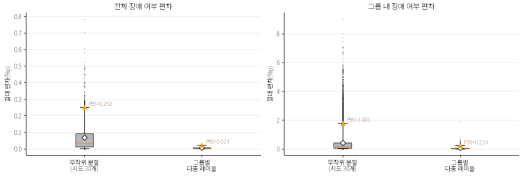
- Reduced obstacle distribution deviation P95 from 0.252 to 0.023 percentage points with multi-label stratification.
- Compared detection formulas, regression, and hybrid approaches.
- Implemented image/structured-feature and gauge ROI models.
- Compared Soft and Hard MoE; achieved a three-seed mean Validation RMSE of 8.39cm.
- Analyzed error and failure patterns by input features, detected ROI, and obstacles.
Multi-label Stratification
Problem
Random splits produced different obstacle distributions, affecting model comparisons. Images with multiple obstacles comprised 24.65% of the data, making single-label splitting insufficient.
Approach
Created 22 groups from gauge type and water level interval. Applied group-wise stratification with multi-label obstacle representation, adjusted target split counts, and compared distribution deviations against 30 random splits.
Results
- Overall obstacle distribution deviation P95: 0.252 → 0.023 percentage points, approximately 90.8% lower
- Within type/level groups: 1.801 → 0.224 percentage points, approximately 87.5% lower
Combining Images and Formula Information
Problem
Formula output could not be generated for 2,854 of the 30,809 Validation images using actual detector outputs. Replacing failed formulas with regression predictions produced RMSE 21.92cm on those samples.
Approach
Compared formula-first, weighted combination, residual correction, and feature fusion approaches. Combined image features with 16 structured values, including formula and regression predictions, failure indicators, reference point counts, and detection confidence. Evaluated formula-failure samples separately under the same Validation set and common initial training conditions.
Results
- Same 2,854 failed samples: regression fallback 21.92cm → feature fusion 11.44cm
- Full Validation set: image regression 15.84cm → initial feature fusion 9.07cm
- Final project model after further training: 30,808 Test images · RMSE 9.52cm
Three Backbones and Soft / Hard MoE
To test whether combining feature fusion and image regression experts added value, I implemented Hard and Soft MoE for ResNet18, ResNet50, and DenseNet121, comparing frozen experts and joint fine-tuning.
Repeated evaluation on the same split with seeds 42, 43, and 44; selected candidates on Validation and checked them on a separate Test set.
Validation RMSE · cm · mean of seeds 42, 43, and 44
| Backbone | Training | Feature fusion | Image regression | Hard | Soft |
|---|---|---|---|---|---|
| ResNet18 | Frozen experts | 9.85 | 10.47 | 9.26 | 9.10 |
| ResNet18 | Joint fine-tuning | — | — | 8.56 | 8.46 |
| ResNet50 | Frozen experts | 10.85 | 10.94 | 10.20 | 10.65 |
| ResNet50 | Joint fine-tuning | — | — | 9.16 | 9.53 |
| DenseNet121 | Frozen experts | 9.93 | 10.33 | 9.69 | 9.48 |
| DenseNet121 | Joint fine-tuning | — | — | 8.68 | 8.39 |
DenseNet121 with Soft MoE and joint training had the lowest mean Validation RMSE at 8.39cm. On the same 30,808 Test images, however, the selected MoE achieved 9.78cm versus 9.52cm for the existing feature fusion model, so the feature fusion model was retained.
Lessons Learned
Aligning Understanding Within the Team
Sharing the reasons and evidence behind choices, as well as approaches and results, helps the team work in the same direction.
Accepting Unexpected Results
Experiments that do not meet expectations still inform the next decision. I learned to revise hypotheses based on evidence.
Deeper Learning Through Mentoring
Mentoring from a Seoul National University doctoral researcher introduced perspectives I had missed while studying alone and encouraged me to ask why new architectures work.